Many years
Of platform development and tailoring as the programme grew

A system developed over years. Layers of linked records and business processes that cannot stop while technology changes. For the AKT programme run by HELVETAS Swiss Intercooperation, we built a new digital platform that unifies management of organisations, users, calls, grants, and reporting. We replaced the existing Drupal and CiviCRM system with a modern application, migrating historical data, documents, user accounts, and their relationships.
Visit the platform ↗
AKT supports civil society organisation development through financial support, mentoring, training, and other forms of institutional development. Such a programme involves a large number of interconnected processes.
Organisations submit call applications. Teams review and score them. Approved projects go through contracting, delivery, monitoring, and reporting. Documentation, communication, and activity history must remain available throughout.
For years, a platform based on Drupal 7, CiviCRM, and Webform was used to manage this information. As programme needs evolved, system complexity grew.
Of platform development and tailoring as the programme grew
Drupal 7, CiviCRM, and Webform in one daily workflow
From call for applications through grant monitoring and reporting
Accounts, organisations, documents, and evaluations in one history
This describes the scope and complexity of the legacy system, without the client's operational metrics.
Migrating a complex business platform is much more than moving data to a new database. Every organisation has its history. Every call has its rules. Every application is linked to users, documents, evaluations, and reports.
In the old system these links were spread across Drupal structures, CiviCRM entities, Webform forms, and custom functionality. The task was to understand, reconstruct, and transfer all those processes into a new architecture.
Years of development left a large number of interdependent features and custom processes.
User accounts, organisations, applications, grants, reports, and documentation had to keep their meaning and relationships.
The new platform had to support real needs of staff and partner organisations without unnecessary complication.
The most important part of migration is not what changes, but what must stay preserved.
Before developing the new platform, understanding the existing one was essential. We analysed data structure, user roles, forms, application flows, evaluations, reporting, and administrative processes. Particular attention went to dependencies between different parts of the system.
Understanding existing functionality, data structure, and how different user groups work.
Design of a new platform with separate user and admin environments, access rules, and linked business entities.
Transfer of existing accounts, organisations, contacts, grants, applications, reports, documents, and relevant links.
Implementation of new user interfaces, admin tools, and processes for call and report management.
Move to the new production platform, with checks of key functionality and user support.
One of the most demanding parts of the project was migration of existing information. Data were not isolated records. Contacts linked to organisations, users to accounts and roles, applications to calls, reports to grants and documents.
The goal was for users to get a more modern system without losing access to data and history built over years.
Continuity without starting over.
The new AKT CRM connects data on organisations, users, calls, applications, grants, and reports. Different users access functionality relevant to their work, while administrators have a central overview and process management.
Central registry of organisations, contacts, and linked users, available according to permissions.
Digital application process with forms, documentation, and statuses, with administrative processing.
Linking supported organisations, grants, activities, and documentation across programme phases.
Structured forms for narrative, financial, and other data relevant to monitoring.
Central environment for users, organisations, content, calls, and records.
Interface through which organisations access forms, applications, and information according to access rights.
Staff manage processes, calls, and records. Organisations complete forms, submit documentation, and report on activities. We built two connected experiences: an administrative environment and a portal for organisations.
Management of organisations, programmes, grants, applications, and reporting processes.
Access to forms, applications, and documentation according to assigned rights.
Structured forms aligned with each process requirements.
Existing data in the system fill fields where provided.
Attachments linked to applications, reports, and records.
Roles and rules determine available information and functionality.
Serbian and English on the platform.
Responsive interface for desktop and mobile screens.
Organisations submit information on activities, finances, results, capacities, and other areas defined by the programme. The new system enables collection and organisation through linked forms and records.
Structured data are the basis for better reviews, analysis, and future visualisations.
Advanced admin visualisations and some integrations were developed in additional project phases. We do not present them as fully complete without confirmation of final state.
Instead of continuing on the existing Drupal 7 architecture, we built a new application on the Laravel ecosystem. The technology choice enabled clearer separation of business logic, data management, user interfaces, and admin functionality.
Functionality organised for maintenance and next development phases.
Admin panel for key business entities and processes.
Permission rules for admin and user responsibilities.
Architecture ready for upgrades and additional modules as the programme needs.
The new AKT CRM platform went live in production on 24 April 2026. The transition included setting up the new production environment, data migration, and enabling user access through the new application.
That laid the foundation for further improvement of business processes, administration, and reporting. The project continued with support, maintenance, and development of additional functionality.
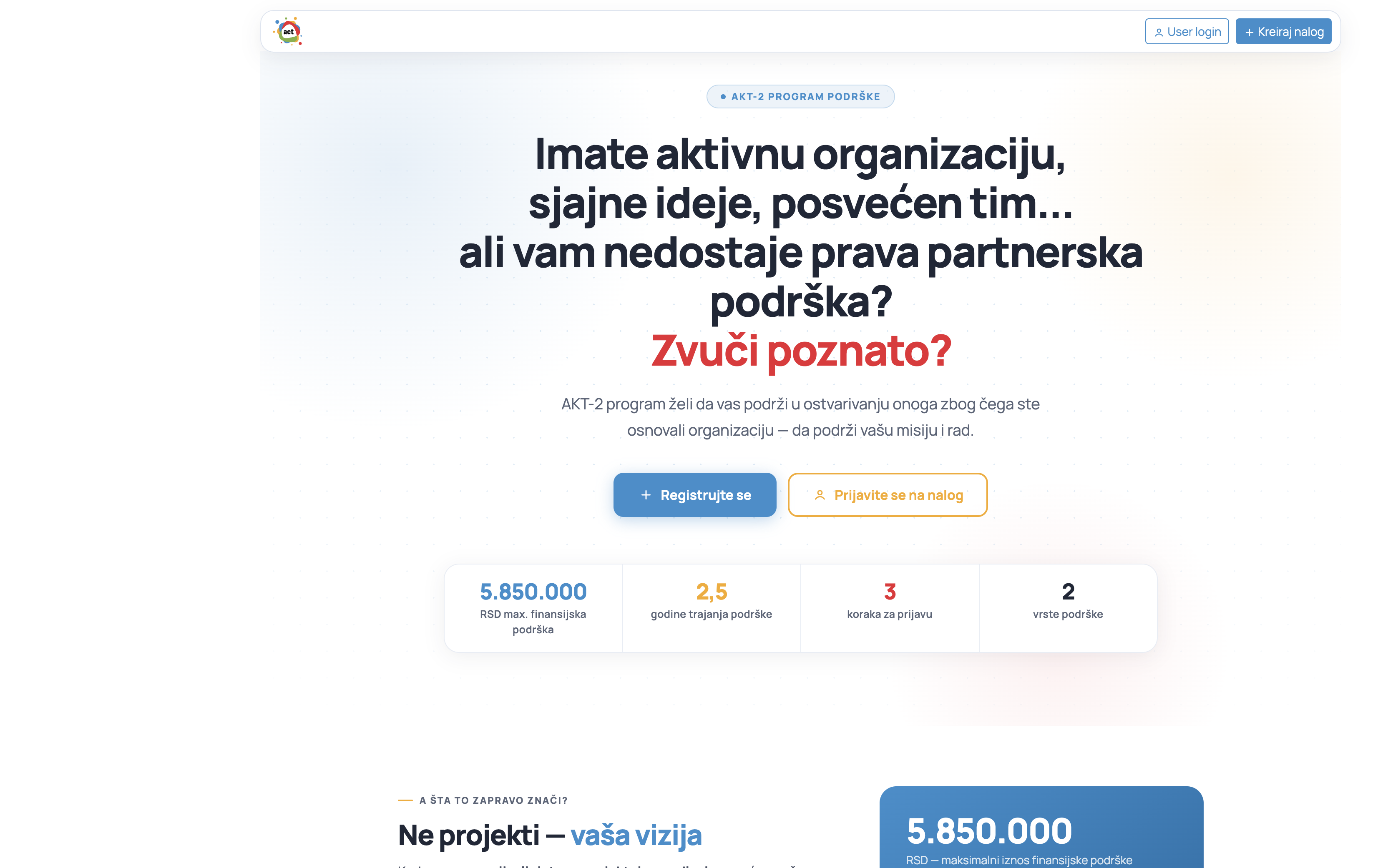
AKT moved from a legacy Drupal and CiviCRM platform to a new MENSCH solution built for programme needs. The new system unifies CRM records, user portal, calls, applications, grants, and reporting.
Historical data and their relationships were transferred to the new architecture, while users received a more modern environment for daily work. This project shows how important it is to understand business processes before changing technology. Successful digital transformation does not end with a new interface. It shows when the system can keep running, evolve, and support the people who depend on it.
Technology changed. Continuity remained.
We develop specialised business applications, CRM platforms, and digital systems that connect data, processes, and people. We analyse existing solutions, design new architecture, and lead development and migration through to production.
Talk about your system ↗