Fragmented data
Information exists in different systems, formats, and sources, without a single way to view it.

Every city has its story. In its streets, public spaces, infrastructure, and everyday experiences of people who live there. The problem is when information about all of that is not available, connected, or clear enough to be useful. Moja Požega is a digital platform that brings together data from different sources and lets citizens actively help build a more detailed picture of their city.
Explore the platform ↗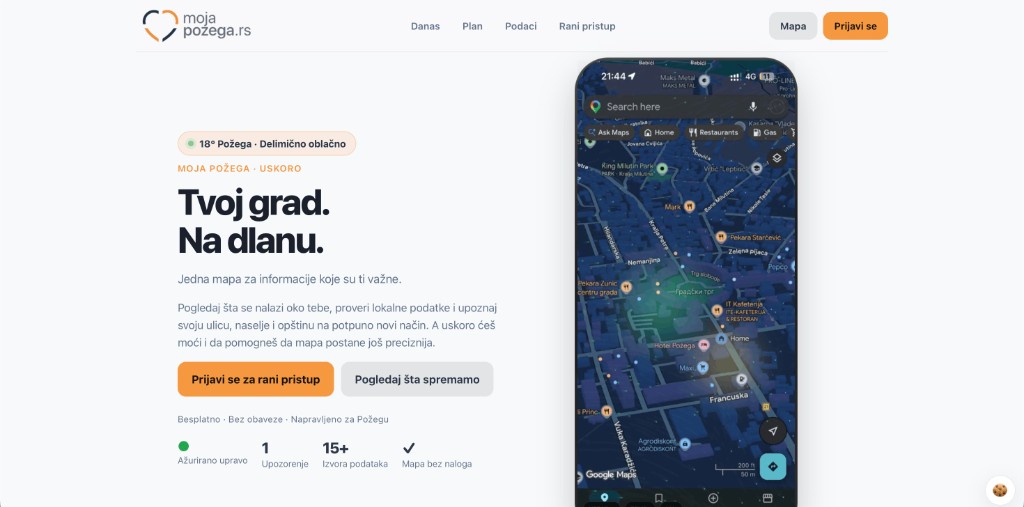
Information on local infrastructure, public spaces, environmental quality, and everyday citizen issues is often spread across different institutions, databases, and digital services.
Some data are publicly available but not easy to find or use. Other information was never systematically recorded in a form that allows overview, analysis, and comparison.
At the same time, citizens notice things existing records do not show: damaged infrastructure, public space problems, utility gaps, or places that deserve attention. There was no single place where all that information could connect.
Information exists in different systems, formats, and sources, without a single way to view it.
Many details important for daily life are not covered by existing public records.
Citizens have direct knowledge of their environment but often lack a simple digital tool to share it usefully.
Instead of waiting for all data to be available in one place, we built a platform that can connect, display, and supplement them.
Moja Požega uses available public data sources and information contributed by citizens. The result is a system that can grow with the city.
Each new piece of information contributes to a fuller view of the local environment, while structured data let individual observations become something searchable, analysable, and usable.
The city is best known by the people who live in it.
Moja Požega connects interactive mapping, citizen reports, publicly available data, and content management tools. The platform is designed to be simple for citizens and flexible enough to support more complex data processing and cooperation with different actors.
Citizens can record locations, problems, and phenomena they consider important for their community. Information is linked to geographic location and the appropriate category.
From utility issues to the state of public spaces, the platform enables structured recording of different everyday situations.
Data from available public and other relevant sources are unified in one user experience, with local context.
The system distinguishes several user types and controls how information is entered, checked, and published.
For the platform we planned connection of different data sources, depending on availability, terms of use, and relevance to the local community. That includes geographic data, weather information, environmental data, and other publicly available datasets.
Data gain value when they become understandable. The goal was not to show as much information as possible, but to let users find what they need, understand context, and link it to real locations.
We show integrations according to actual production state. Sources marked as "supported" or "planned" are not presented as active until integration is confirmed.
Geographic data and locations
Geographic and location services on the map
Data relevant to Požega and Serbia
Contributions with moderation (in preparation)
European environmental data
Satellite and scientific datasets
Platform complexity stays in the background. The user should find a location, review available information, or send a report without knowing GIS systems, administrative procedures, or database structure.
Address and location search lets users quickly reach places that interest them.
The reporting process is organised so the user can enter relevant data and link it to a location.
Reports and other user content are organised through categories and appropriate management mechanisms.
The platform is designed as a Progressive Web App, with an experience suited to mobile use.
Behind the user interface is a system for managing different types of information, user roles, and content processing. The architecture allows functionality to grow and expand without solving every new requirement from scratch.
Linking information to specific locations and geographically organised content.
Different access levels for citizens, institutions, partners, and moderators.
Central management of categories, content, users, and verification processes.
Structure that enables connection with external data sources and services.
Responsive PWA approach, adapted to different screen sizes.
Access control, validation of user input, and protection of publishing processes.
One citizen notices a problem on the pavement. Another knows where public lighting is missing. A third has information about space that could be used better. Individually, those are small observations. When recorded in one place, they become part of a wider picture.
Moja Požega was developed with the idea that citizens are active participants in collecting local information, while institutions and other actors get a better basis for understanding community needs.
The platform alone does not solve every reported problem. It makes problems and information more visible, organised, and easier to use further.
Moja Požega is conceived as long-term digital infrastructure. A modular approach allows gradual introduction of additional functionality, data sources, and cooperation models.
Potential development directions include more detailed records of local infrastructure, additional environmental data, cooperation with public institutions, improved analytics views, and new community engagement models. Every extension should have a clear purpose: making information more available and useful.

By developing the Moja Požega platform, a digital product was established that connects local information, geographic context, and direct citizen participation.
The project shows how combining product thinking, design, software development, and working with data can produce a system for the concrete needs of one community. Its value is not in the number of screens or features, but in the ability to present information that was previously hard to access or disconnected in one place.
Better decisions start with better information.
We develop digital platforms, specialised applications, and systems that connect data, people, and business processes. From first idea to a product ready for real use.
Talk about your project ↗